Visualizzazione post con etichetta House Rules. Mostra tutti i post

domenica 24 marzo 2013

House Rule: Torches Shall Be Consumed!


I've always considered timekeeping pretty annoying in old-school gaming: keeping track of turn-based spells' duration, shifting from rounds to turns or the consumption time of a torch have always been a burning thorn in my dark hole.

With this post I just wanna focus on torches, because in the past - as a DM and also as a player - my gaming groups have always neglected their durability while exploring multi-layered dungeons.

This HR handles this in a very simple way, with a 4+ roll and the use of the so called dice chain (i.e. scaling from a die to another die with less faces): as long as a torchbearer rolls 4+ the torch consumes regularly, otherwise it consumes faster.

Every brand new torch starts with a d12 (let's call it torch die), torches hanged in a dungeon's room can start with a smaller die. Whenever the party visits 4 rooms (combat counts as 2 rooms in addition to the room where it takes place, moving back to a previously visited room still counts as 1), each torchbearer must roll the torch die: if he rolls 4+ he keeps the same torch die, otherwise with 3- the torch die scales down to the closest die (from d12 to d10, from d10 to d8, from d8 to d6, from d6 to d4).

The torch will stay lit until the torchbearer fails the roll with the d4, causing the torch to exhaust definitively.

lunedì 9 luglio 2012

Ten Commandments Sword in the Stone

The original Ten Commandments Sword is a shapechanging sword created by the mangaka Hiro Mashima in his fantasy manga Rave, able to take the form of ten different powerful swords: my purpose is to blend this concept with King Arthur's famous sword in the stone, turning the TCS into an artifact for D&D/AD&D.
 
Long time ago, an ancient Evil wreaked havoc in the known world: nations have been wasted, innocents have been sacrificed, fear and terror ruled above all.

In the deepest darkness, the beacon of Hope was enlighted by ten heroes.
A harsh warrior from the North, trusting the power of his sword.
A reckless boy, always risking his life for the sake of Good.
An elf from the Emerald Forest of Elves, as fast as lightining.
A warlock, master of forbidden secrets.
A swordmaster, with a blazing heart and a cold mind.
A brave woman, striking his foes like a whirlwind.
A huge knight, able to withstand alone the strongest giant.
A mysterious man, harbinger of the Power of Light.
A merciless swordman, possessed in battle by a bloodlust frenzy.
A man of faith, fighting in the name of Justice.

The power of Ten defeated the Evil, bringing peace back in the known world.
Nine of Ten perished during the battle, only survivor was the warlock.
Ten Swords became One, with warlock's last magic.
Plunged in the Stone of Oath, the One will grant his power to chosen one.


The Sword of Oath looks like a slightly rusty blade stuck in an obsidian decagonal stone, but it owns amazing powers: in the hands of the chosen one, it will grant him the power of one of the then heroes.
Roll 1d10 to determine which form the sword will assume.

 1 - Eisenmeteor
This massive +2 great sword allows its user to overcome any sort of damage immunity (like vampire's or lycanthrope's) from non-magical weapons against a physical target; it can't be affected by spells targeting magic weapons.


2 - Explosion
Everytime this +2 long sword deals maximum damage, it engulfs a 5ft. area around its user with an explosion: doing so it deals 1d8 bonus damage to every adjacent opponent and 1d3 damage to the user.


3 - Silfarion
This +2 long sword is weightless, and it works exactly like a pair of Boots of Speed.


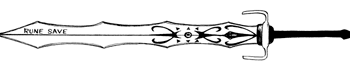
4 - Runesave
This +2 long sword has no sharp edges; it deals 1d3 against tangible opponents and 1d10 against intangible opponents (like a ghost); 1/day it can also dispel a single spell.


5 - Blue Crimson
One sword is coated by small flames, the other releases small shards of ice.
Whenever the user attacks with these +2 long swords he rolles 2d8 for damage and drops the lowest (coounting thus as a single attack), choosing on the moment if dealing fire damage or cold damage.

6 - Mel Force
This +2 long sword whistles everytime its owner swings it, and can create 1/day a paralyzing gust of wind (working like the Web spell); in addition its user is constantly under the effects of the Levitate spell.


7 - Gravity Core
This massive +2 great sword deals 2d8 of damage, but the owner suffers a -4 penalty to hit rolls for its weight.


8 - Million Suns
This +2 long sword has a blade made of solid light, and it works like a Sun Blade.


9 - Sacrifar
This +3 long sword (dealing damage as a great sword) switches the character's alignment to Chaotic (until a Remove Curse spell is cast upon him) and forces its user to attack everybody within a 10 ft. radius; at the end of the combat the character need to rest in place for 1d4 turns.

10 - Rawelt
This +2 long sword works exactly like a Holy Avenger, but it grants also to non-paladins its +10 bonus to damage against Chaotic (or Evil in AD&D) creatures.

lunedì 30 aprile 2012

Ruins & Radiations: House Rules for a S&W/LL Science Fantasy Campaign

After I've dropped several projects of mine, finally I've collected the House Rules I've used in Swords&Wizardry my science-fantasy campaign (but you can easily use them with Labyrinth Lord).

Basically that's what they do:
  • They allow you to make custom classes (like Thief, Bard or Paladin) starting from the six core classes (Fighter, Magic User, Cleric, Halfling, Dwarf and Elf)
  • They use a roll-under resolution for combat (with a descending Armor Class), skills and saving throws
  • There's a revised system, still pseudo-vancian (same old spell slots) but with a more talislantan-style approach (spells created on the fly and possible mishaps)

Enjoy it. ^_^

sabato 30 luglio 2011

House Rule: Alternate XP Progression for Demi-humans


Yes, I know that D&D - from a gygaxian perspective - was originally a humanocentric game as clearly shown through level cap in class advancement.. but that's not so appealing to me.

Level caps usually exist to balance the game, because demi-humans usually have particular features - like infravision, spotting or underground lore - and a longer lifespan that humans don't have (in game terms): but that's only a short-term balance.

I mean to say that's pretty absurb thinking about a 7th level Fighter as the strongest elvish champion or a 11th level Wizard as the strongest elvish magician (whereas elves usually are renowned as skilled spellcasters) in AD&D.

Yeah, demi-humans can multiclass (whereas humans can't) but IMHO that's not enough.

That's why, in my regular games, I've replaced level caps with a XP Progression Slowdown (besides Minimum Ability Scores): this way you can have higher level demi-human heroes, paying that with more likely XP penalties (or lack of bonuses).


XP Progression Slowdown for Demi-human Characters

Requirements: Minimum Abilities Scores (if any; otherwise Con 10 for Dwarves/Gnomes, Dex 10 for Elves/Halflings, Str 10 for Half-orcs)
Prime Requisite: as per Class
Hit Dice: as per Class
Maximum Level: None
Features: as per Class
XP Progression: as per Class
XP Bonus/Penalties: consider your Prime Requisite 4 points lower than its real score (only in terms of earned XP variations)


In an OD&D game that means if you have in your party a human Fighter and a dwarf Fighter - both having Strength 16 as Prime Requisite - the first one will get a 10% to earned XP (thanks to a score greater than 15) while the second will have no bonuses to earned XP (because his Prime Requisite drops to 12).

That's a pretty nice option to me.

Artwork by Larry Elmore.